LCR P1 Multifunction Transistor Capacitor Tester About
LCR P1 Multifunction Transistor Capacitor Tester
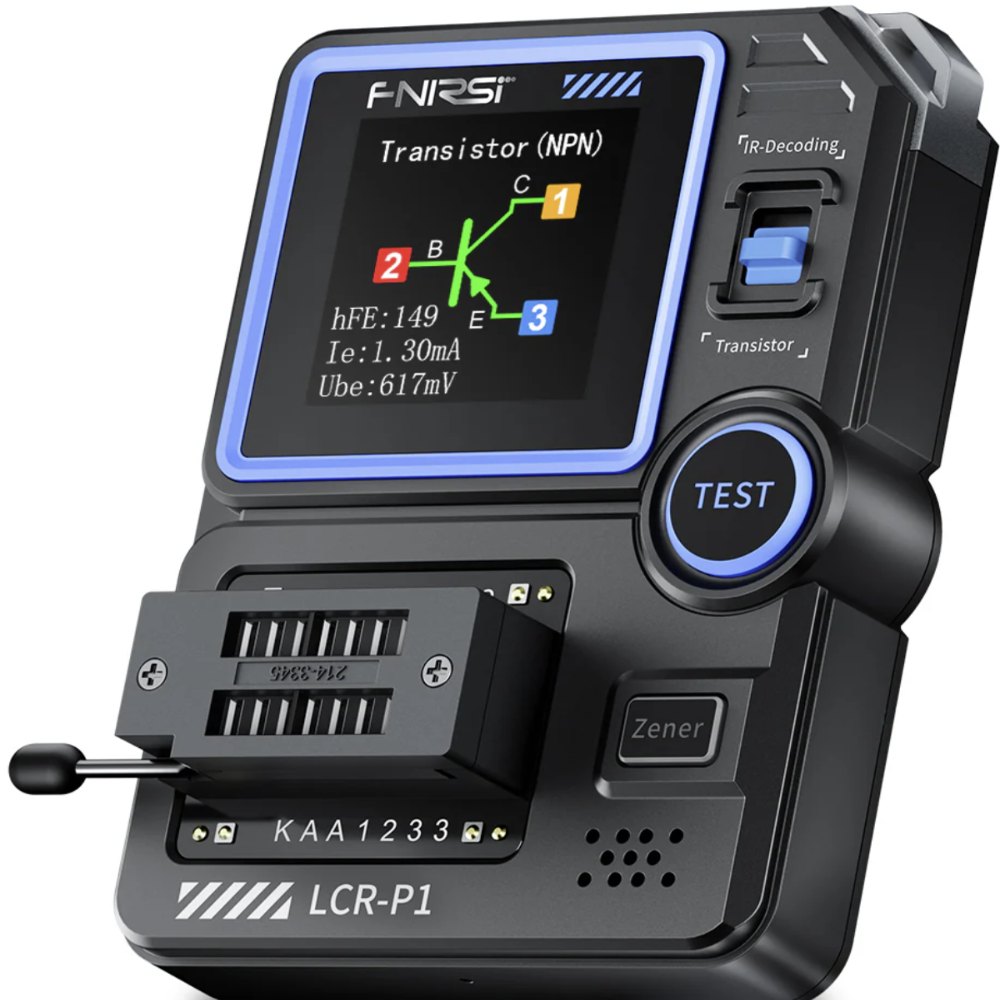
The LCR-P1 Transistor Tester is a high-precision, multifunctional electronic testing device designed specifically for electronic engineers, technicians, and enthusiasts.This device is intended for detecting and analyzing the performance and characteristics of semiconductor components such as transistors, diodes, triodes, and field-effect transistors (FETs).Equipped with a color screen, it allows for multi-parameter measurement of various components, automatically identifies the type and pin arrangement of the tested component, simplifying the operation process and enhancing testing efficiency.
Features:
Versatile Tester: FNIRSI LCR-P1 measures transistors, capacitors, resistors, inductors, diodes, MOSFETs, and batteries.
User-Friendly Design: Features a replaceable patch seat, 1.44-inch color screen, 300mAh battery, and Type-C charging/data port.
Anti-Burn Protection: Automatically discharges undischarged capacitors to prevent accidental damage.
Infrared Analysis: Supports NEC infrared protocol analysis for remote control debugging and maintenance.
Smart Identification: Automatically detects component pins, parameters, and specifications for faster work efficiency.
Precision Testing Across All ComponentsEngineered for versatility, the LCR P1 Tester can automatically identify and test most discrete electronic components. Whether you're analyzing transistors, capacitors, resistors, or diodes, its broad measurement range and high accuracy ensure reliable performance every time. The user-friendly interface and graphical on-screen pin-out display make setup and operation fast and foolproof.
Convenient Features for Everyday UseEnjoy the benefits of practical design features, including a bright backlit color LCD, data hold, auto power-off, and battery condition indicator. The intuitive rotary encoder simplifies menu navigation, while the robust ABS plastic body ensures long-term durability for handheld or benchtop use. Its compact size and included test leads mean it's always ready for immediate use in the lab, workshop, or classroom.
FAQ's of LCR P1 Multifunction Transistor Capacitor Tester:
Q: How does the LCR P1 tester automatically identify different transistor types?
A: The LCR P1 tester features intelligent auto-detection technology that recognizes and classifies transistor types such as NPN, PNP, MOSFET, JFET, and IGBT as soon as you place them in the socket. It then displays the exact pin-out configuration graphically on its LCD screen for easy and accurate placement.
Q: What types of components can I test with the LCR P1 Multifunction Tester?
A: This tester supports a variety of electronic components, including resistors, capacitors (up to 100mF), inductors, diodes, SCRs, transistors, MOSFETs, IGBTs, and more. It is suitable for both standard leaded and small-sized components commonly used in electronics repair and education.
Q: When should I use the ESR measurement feature?
A: The ESR (Equivalent Series Resistance) measurement function is particularly useful when checking the health of electrolytic capacitors. High ESR readings can indicate degraded or failing capacitors, which is important for diagnosing power supplies or audio circuits.
Q: Where can I use the LCR P1 tester?
A: Thanks to its robust ABS housing, lightweight design, and battery operation, the tester is suitable for use in laboratories, repair workshops, educational settings, or for field testing wherever electronic component validation is required.
Q: What is the process for testing a component with this device?
A: Simply insert the component into the appropriate socket or connect it via the supplied test leads. The tester will automatically identify the type, execute the test within 2 seconds, and present detailed parameters-including a graphical pin-out-on the screen. You can then use the rotary encoder to navigate further options or hold the data on display.
Q: How does the continuity test work and what are its benefits?
A: To perform a continuity test, connect both ends of the circuit under test to the device. If the path is complete, the tester emits an audible buzzer-ideal for rapidly identifying breaks in wiring and ensuring circuit integrity during repairs.
Q: What advantages does the data hold function offer during testing?
A: The data hold feature allows you to retain the measurement results on the display, making it easier to record, share, or compare values without needing to perform repeated tests, which is particularly valuable in multitasking environments or educational demonstrations.







 Send Inquiry


 Send Inquiry
 Send Inquiry
 Send SMS
 Call Me Free