2C53TS Digital Storage Oscilloscope About
2C53TS Digital Storage Oscilloscope
Features:
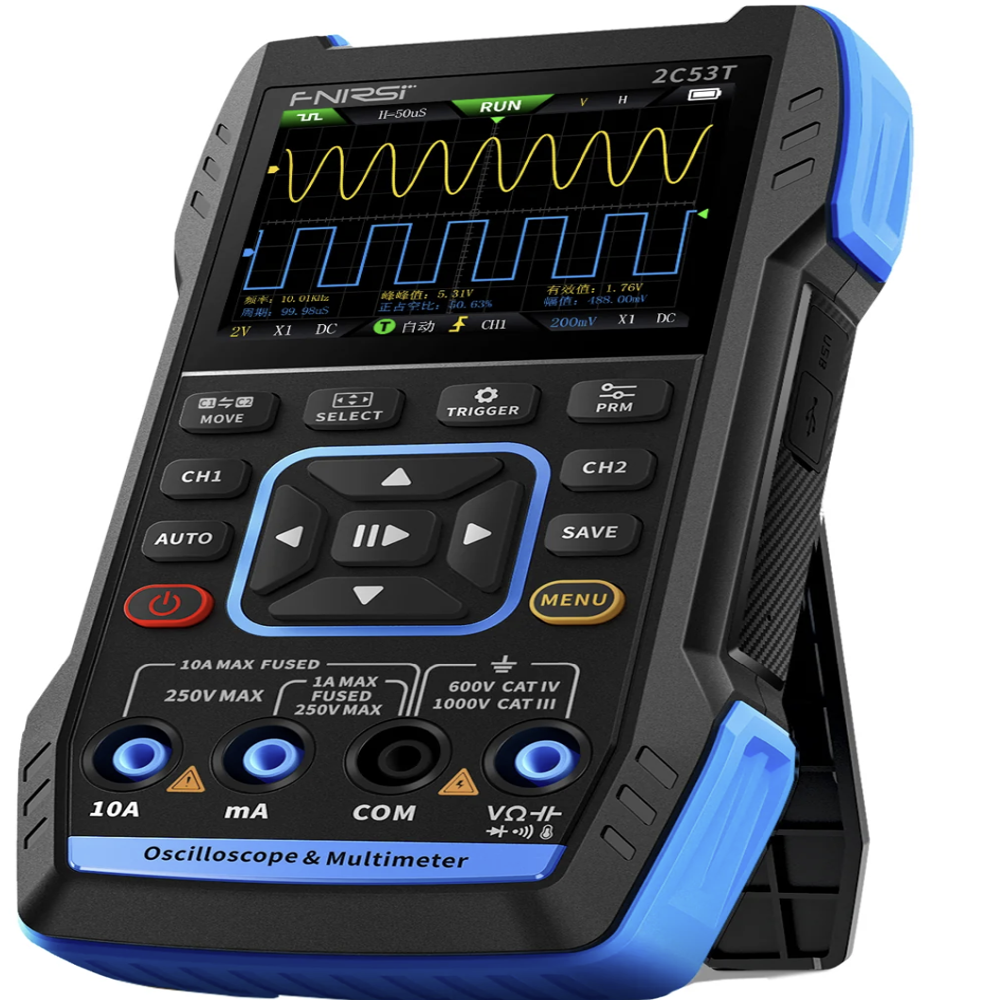
Newly Version: The 2C53T is an upgraded version of the 2C23T, which improves the measuring range and adds math operationcursor measurementpersistence modeXY mode features.
2 Channel Oscilloscope: 50 MHz bandwidth, 250MSa/s sampling rate, 1Kpts record depth, automatic measurement function, max voltage 400V, vertical sensitivity 10mV/div-10V/div , support waveform image storage and export.
4.5-Digit 20000 Counts Multimeter: AC Voltage: 0-750V, DC Voltage: 0-999.9V, DC/AC Current: 0-9.999A, Resistance: 0-19.99M, Capacitance: 0-99.99mF, Continuity Measurement. Multi-function meter for professionals, schools and hobbyists.
Signal Generator: The maximum waveform output frequency can reach 50kHz and a step of 1Hz, and can output 13 waveforms.
Save function: one-click save, screening function. You can upload the saved image by connecting to PC via Type-C. You can easily compare the waveforms by displaying the reference waveform and the measured waveform on the same screen.
Excellent Design: The Oscilloscope adopts FPGA + MCU + ADC hardware architecture, built-in high-voltage protection module, adopts 2.8 inch LCD display, built-in 3000mAh Li-ion battery, standby time up to 6H, Type-C interface supports 5V/1A charging.
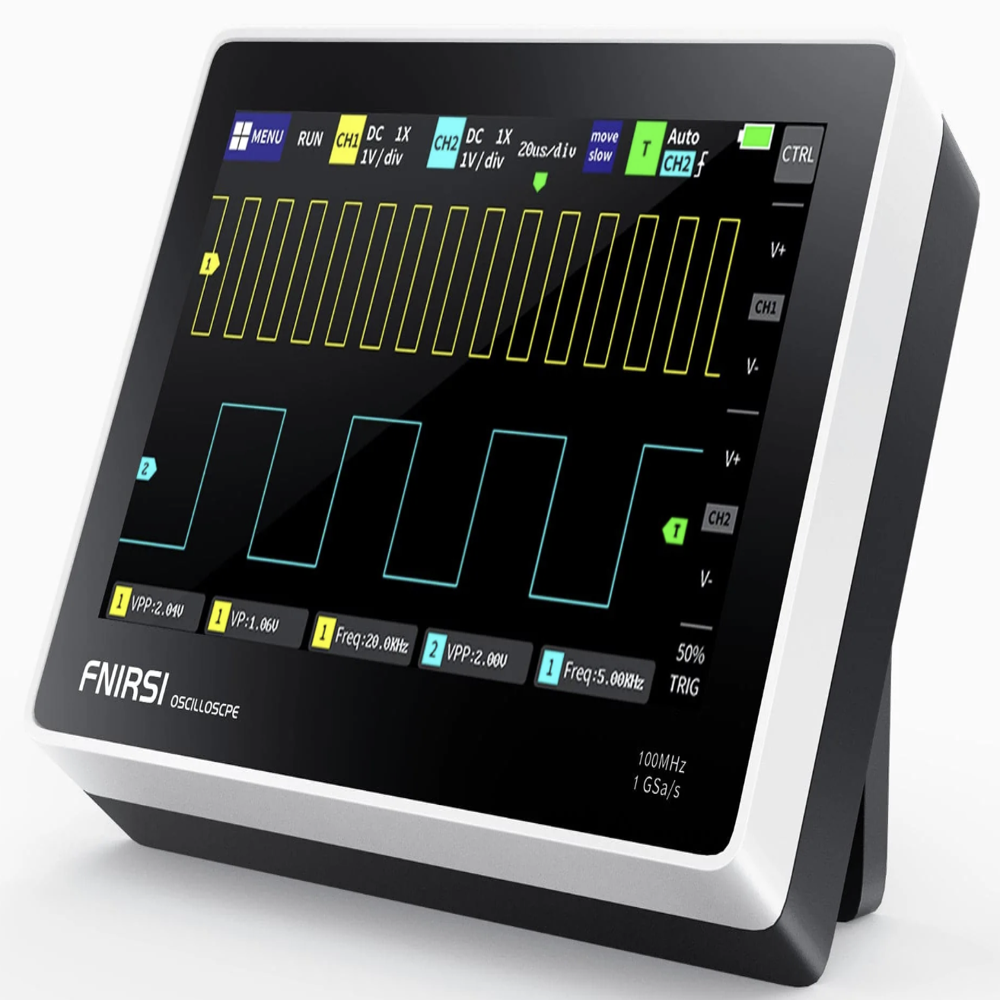
High Precision and VersatilityThe 2C53TS oscilloscope supports a broad range of vertical sensitivity from 2 mV/div to 10 V/div, and time base settings from 2 ns/div to 50 s/div. It offers accurate signal representation up to 200 MHz bandwidth, leveraging an 8-bit vertical resolution to reveal finer signal details. Its broad trigger modesedge, pulse, video, slope, and alternatelet users capture exactly the data they need.
User-Friendly Controls and ConnectivityDesigned with ease of use in mind, this oscilloscope features digital controls, auto measurement, intuitive math functions, and a 7-inch color TFT-LCD. Connectivity is comprehensive, with USB host, USB device, LAN, Pass/Fail, and TRIG OUT ports, facilitating data transfer, remote control, and integration with broader test systems.
Robust Construction for Diverse EnvironmentsThe 2C53TS accommodates a working temperature range of 0C to 40C and humidity up to 85% RH, making it suitable for varied laboratory, service, and educational environments. Its lightweight (approx. 2.5 kg), desktop design ensures portability without compromising on performance or durability.
FAQs of 2C53TS Digital Storage Oscilloscope:
Q: How does the 2C53TS oscilloscope benefit electronics troubleshooting and waveform observation?
A: The 2C53TS provides high sample rates, multiple trigger modes, and precise vertical sensitivity, allowing users to capture and analyze complex electronic signals in detail. This enables effective troubleshooting, waveform observation, and diagnostics in both development and maintenance tasks.
Q: What is the process for saving waveform data and measurements on the 2C53TS?
A: You can easily save waveform data and measurement results using the USB host or device ports. The oscilloscopes auto measurement and storage functions streamline data archiving, so you can efficiently document and manage your findings.
Q: When should I use the different trigger modes available on this oscilloscope?
A: Trigger modes such as edge, pulse, video, slope, and alternate allow you to tailor signal capture to specific events. For example, edge triggering is ideal for general waveform analysis, while pulse or video triggers are useful for more complex signal characteristics or video signal analysis.
Q: Where is the 2C53TS digital storage oscilloscope best utilized?
A: This model excels in laboratory, educational, and electronics service settings, offering reliable performance for electronic signal analysis, circuit troubleshooting, research, and classroom demonstrations.
Q: What are the key usage steps to perform electronic signal analysis with this oscilloscope?
A: Connect your test leads to the channels, select the appropriate probe attenuation (1X or 10X), configure time base and vertical sensitivity, and choose the trigger mode based on your signal characteristics. Use the display to observe waveforms, employ auto measurement functions, and save data as needed.
Q: How does its digital control mode enhance user experience?
A: Digital control mode ensures precise parameter adjustments, quick access to measurement and storage functions, and a more intuitive workflow, reducing setup time and improving usability for both novice and experienced users.







 Send Inquiry


 Send Inquiry
 Send Inquiry
 Send SMS
 Call Me Free