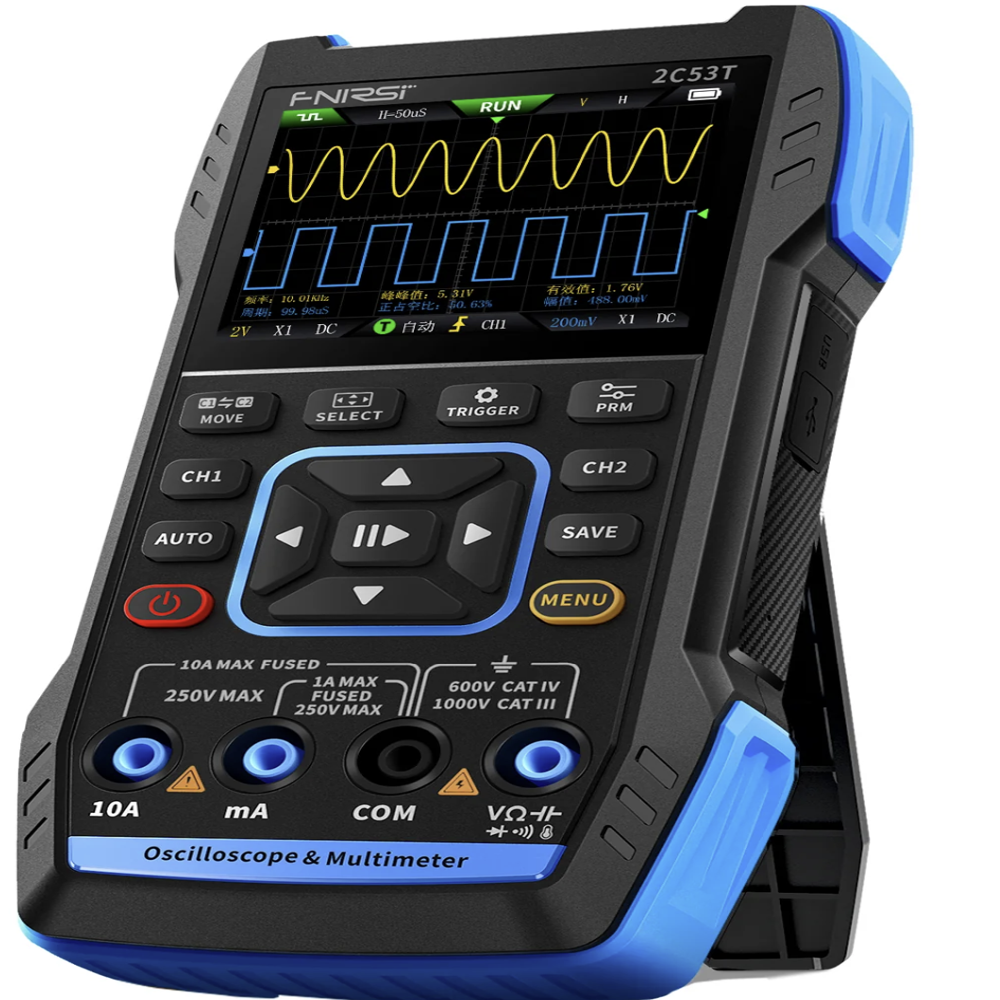
2C53T Digital Storage Oscilloscope About
2C53T Digital Storage Oscilloscope
Features:
Oscilloscope Mode: Dual-channel handheld oscilloscope with 10 MHz bandwidth, 50 MSa/s sampling rate, 32 kb record depth, automatic measurement, max voltage of 400 V, vertical sensitivity 200 mv/div-10 v/div, and waveform storage/export.
Multimeter Mode: 4-digit 10,000 Counts. AC Voltage: 0-750 V, DC Voltage: 0-999.9 V, DC/AC Current: 0-9.999 A, Resistance: 0-99.99 M, Capacitance: 0-99.99 mF, Continuity Measurement. Multi-function meter for professionals, schools and hobbyists.
Signal Generator: The maximum waveform output frequency can reach 2 MHz and a step of 1 Hz, and can output seven waveforms including sine, square, triangle, full, half, noise, and DC.
Save Function: One-click save, screening function. You can upload the saved image by connecting to PC via Type-C. You can easily compare the waveforms by displaying the reference waveform and the measured waveform on the same screen.
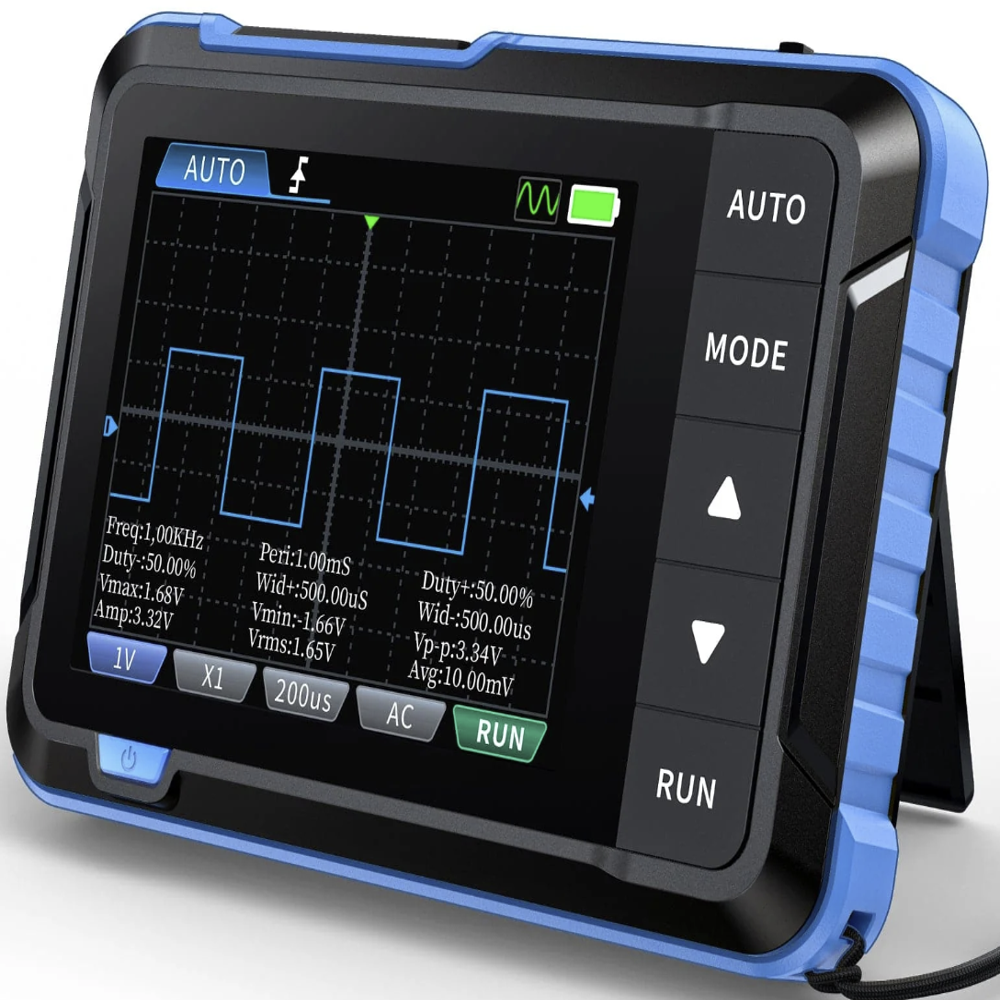
Excellent Design: The Oscilloscope adopts FPGA + MCU + ADC hardware architecture, built-in high-voltage protection module, adopts 2.8 inch LCD display, built-in 3000mAh Li-ion battery, standby time up to 6H, Type-C interface supports 5V/1A charging.
Precision Signal Analysis Made SimpleBoasting a broad measuring range and robust real-time sample rate of 500 MS/s, the 2C53T Digital Storage Oscilloscope is engineered to catch fast or infrequent signals with superb accuracy. The dual-channel configuration and advanced triggering ensure that complex electronic signals can be captured and explored efficiently.
Versatile Features for Comprehensive TestingEquipped with manual, track, and auto cursor measurements, as well as math functions such as FFT, add, subtract, and multiply, the 2C53T covers a wide array of diagnostic and analysis needs. Its storage capacity for 10 waveforms and setups, plus USB connectivity, enables efficient workflow and easy data management.
User-Friendly Design and OperationWith its intuitive digital control mode and clear, full-color LCD display, the 2C53T is approachable for both beginners and professionals. Compatibility with Windows for PC software, easy autoset features, and support for common probe attenuations improve both ease of use and flexibility in various testing environments.
FAQ's of 2C53T Digital Storage Oscilloscope:
Q: How do I connect and operate the 2C53T Digital Storage Oscilloscope for signal measurement?
A: Simply connect your probes to the standard BNC input channels, power up the device (100-240V AC), and use the intuitive digital controls to set your vertical and horizontal ranges. The oscilloscope supports autoset, making initial setup easy, and displays signals clearly on its 7-inch TFT LCD.
Q: What types of signals and measurements can the 2C53T capture and analyze?
A: The oscilloscope can measure a wide range of electronic signals up to 50 MHz bandwidth, with vertical sensitivity from 2mV/div to 5V/div and a time base from 2ns/div to 50s/div. It supports edge, pulse, video, slope, and alternate triggers, as well as various math and auto measurements.
Q: When should I use the autoset function on this oscilloscope?
A: Use the autoset function when you need a rapid setup for new or unknown signals. It automatically adjusts the vertical and horizontal settings, allowing you to view and analyze waveforms more quickly and with minimal manual intervention.
Q: Where are saved waveforms and setups stored, and how can I retrieve them?
A: The 2C53T allows you to store up to 10 waveforms and 10 setups internally. You can also transfer data to a PC for further analysis or archiving via the oscilloscope's USB or LAN interface, compatible with Windows operating systems.
Q: What is the process for using cursor measurement and math functions on this model?
A: To use cursor measurements, select from manual, track, or auto modes to precisely determine signal parameters directly on the display. Math functions such as add, subtract, multiply, and FFT can be accessed through the menu to analyze complex signal relationships and frequency components.
Q: What benefits does the high-resolution color display offer users?
A: The 7-inch LCD with 256 colors and 800 x 480 resolution vividly displays waveforms and measurement readouts, making signal distinctions clearer and improving user confidence in detailed analysis, even in complex troubleshooting scenarios.






 Send Inquiry


 Send Inquiry
 Send Inquiry
 Send SMS